
Free sample. This chapter is one of two shared free from the book. Buy the complete book.
Section One
1a Of “Slight” German Descent 1849
Walter Joseph Host was born at Jaspers Brush in September 1896. “The Brush”, as it was known, was not even a hamlet since it had only two public buildings, a small one-teacher school and a dairy Co-Op which received the milk produced on local farms and delivered it to the nearby railway station for transport to the cities of Sydney and Wollongong. Jaspers Brush was situated just south of the town of Berry on the South Coast of NSW and lay on the Prince’s Highway between Nowra and Kiama. For much of its early history, Berry depended on timber cutting and dairy farming, with a tannery and boat building providing some employment for local workers. The curious name was coined by an early settler, John Ingold, as a tribute to his brother, Jasper, who died in 1860 before he could leave England for Australia. The “Brush” referred to the dense rainforest which once covered the steep hillsides before the timber was felled to make way for dairy farming and cattle grazing.
Walter was the youngest child of Louis Charles Host, who was the second son of German immigrants, Johann “Jean” Host and Elizabeth Englehardt. This couple had married in the hillside town of Keidrich in the state of Hessen, Germany, only a week before they had departed for Australia in 1849. The newly wed pair had decided to flee a land which at that time was racked with war and revolution. In 1849 they arrived in Sydney per the vessel Parland and were sent to Kiama on the South Coast of NSW, where they were employed as indentured vine dressers by a well-to-do landowner, James Robb.
The Parland, and a vessel called the Buelah, had brought German immigrants, mainly young couples who had particular skills, such as pruning and cultivating vines associated with grape growing. The vine dressers had been raised in the Rhinegau, a famous wine producing district located between the German cities of Mainz and Frankfurt. In fact, Jean Host was not a wine grower but a middle class watchmaker and jeweller, who was a burgher of his town. Despite being handicapped by a club foot, like all children living in a wine growing region, Jean had grown up working in the vineyards in the long summer vacations and was expert in shaping and cutting the vines in the spring and autumn to maximise their growth in the short growing season.
Like many German immigrants, the six surviving Host children grew up with little connection to the native land of their parents. As the years passed they understood only the basic rudiments of the foreign language and they adopted Protestant Anglicanism rather than the Catholic beliefs of their parents simply because, in their childhood years, there was no Catholic Church in Kiama. The third generation Host children had not known their grandparents, both proud “natives of Germany” according to their tombstone, because the immigrants had died before the grandchildren were born.

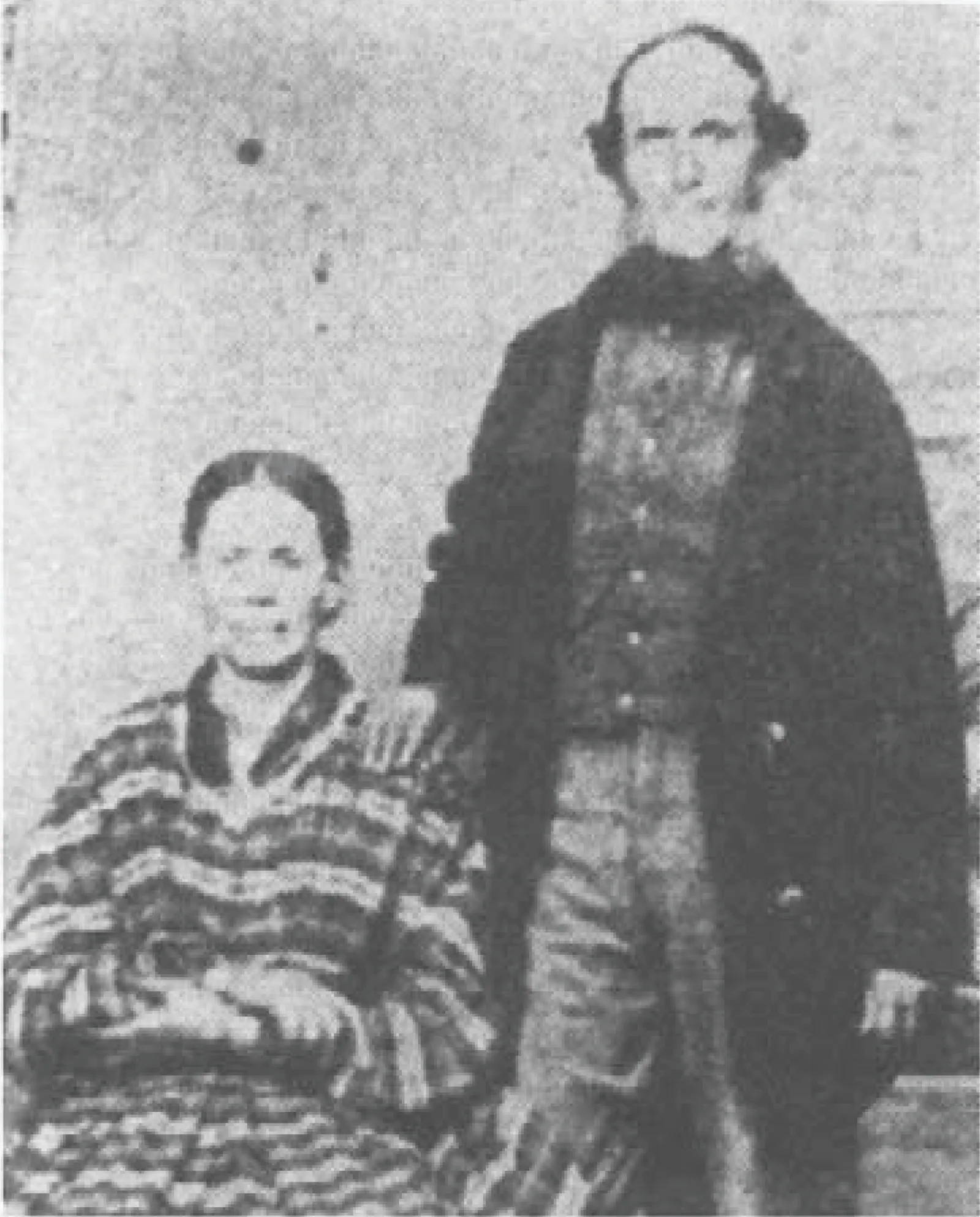
Johann “Jean” Joseph Host and Elizabeth Englehardt
In 1860 Jean was naturalised as a British subject and he purchased land at Broughton Vale near Berry. Jean is credited with having been among the first wine producers in the Shoalhaven district. Following the death of his wife, Jean became a publican in Sydney but he drowned in the Shoalhaven river during a visit to his family.
The couple, both “natives of Germany”, were buried in the old Nowra Catholic Cemetery.
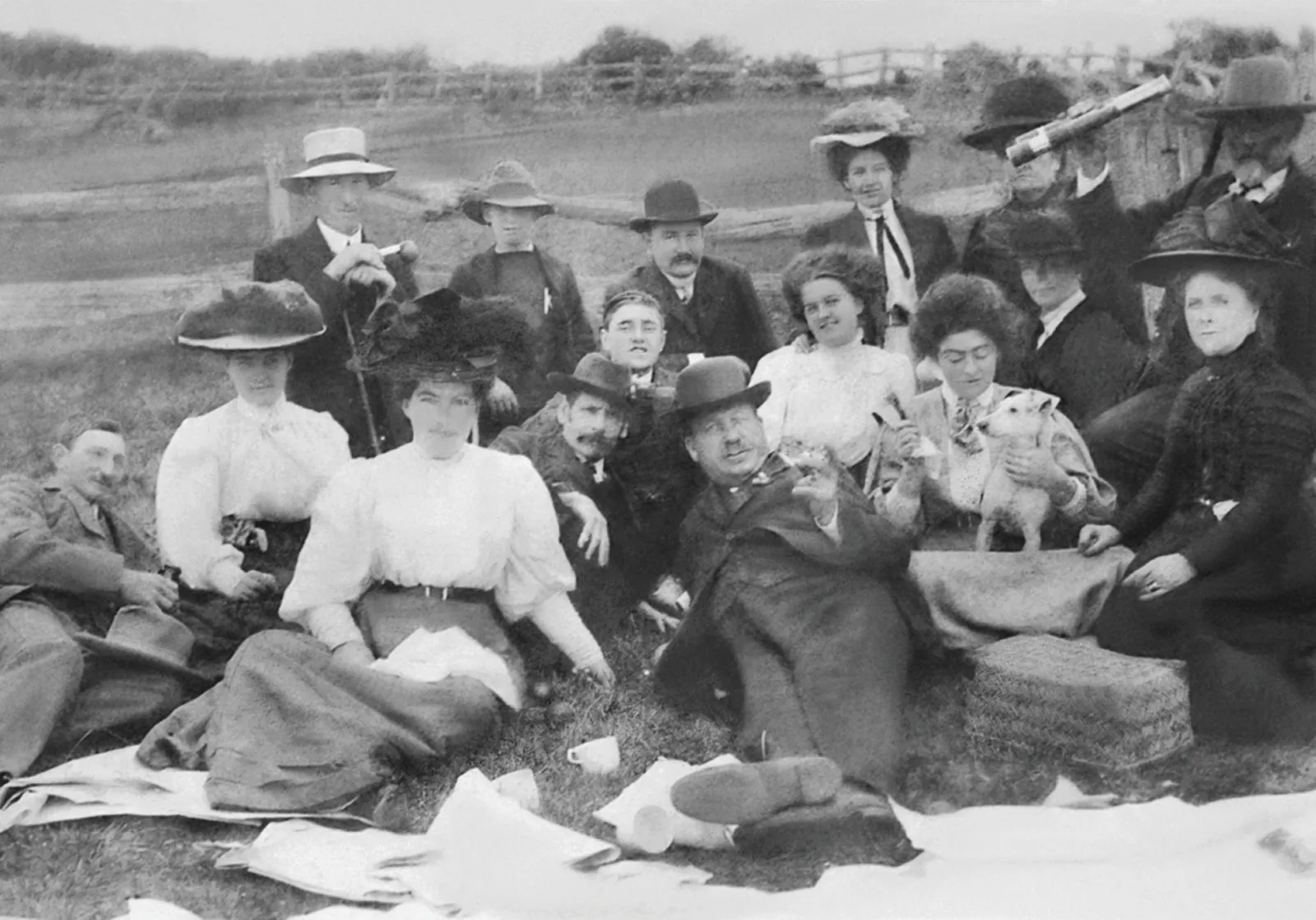
Back row, left to right: William Wilson, Walter Host, Ernest Host and his future wife Jenny Gall,
Granny Reid (hidden behind telescope), Louis Host.
Front row, left to right: Thomas Gall with future wife Susan Host, Victoria Host (William
Wilson’s future wife), David Host, Herbert Host, George Host, Miriam Host, unknown lady with
dog, Alfred Host, and mother Lizzie Host.
1b The Parents of Walter Host
Louis Charles Host and Mary Elizabeth “Lizzie” Reid - 1850/60 - 1930s
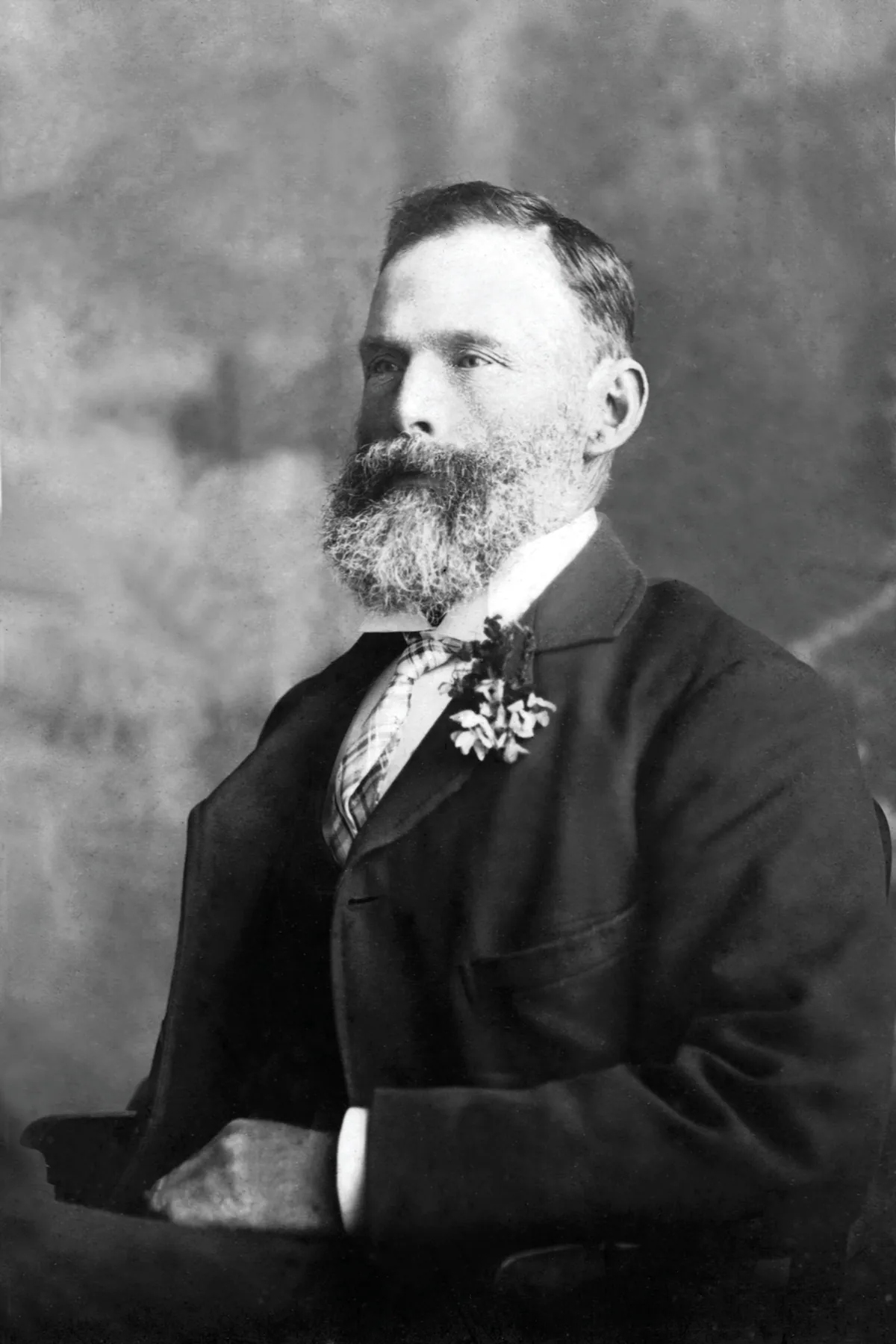
As a young man, Louis Host earned a good living as a teamster, hauling supplies to the Southern Highlands and the Yalwal gold fields. He also bought land, first at Falls Creek near Nowra and then on the outskirts of the vast estates of David Berry in the Shoalhaven Valley. A tough, determined, forceful, hard-working and frugal man, Louis invested wisely so that, on retirement at the age of sixty, he was able to sell his farm to his own son and so provide each of his boys with sufficient money for them to buy blocks of land, farms or businesses in the district.
When growing up, all of the Host sons lived in some fear of their father who as a young man had lived alone on the brawling gold fields and knew how to defend himself with a gun or whip. However, Louis was also an intelligent and thoughtful man who was largely self taught, literate in two languages and who, through hard work, had built up his personal fortune so that he was able to serve on many local committees, provide a comfortable home for his large family and, as a grazier of independent means, make provision for his sons and daughters when the time came for them to leave home. Bluff and hearty in manner, Louis was a strict but fair father who regarded it as his duty to do his best for his offspring, and over the years he distributed gifts in cash to his sons at age 21 and provided lavish weddings and endowments for his daughters. A fine horseman, who even in old age, rode tall and erect in the saddle, Louis Host was a domineering figure who taught his sons to be self sufficient, good horsemen and able to shoot a rifle with confident marksmanship.
Mary Elizabeth Reid was of Protestant Scottish-Irish descent. Her mother, Susan Morrow, had arrived in Australia as a child in 1841 per the vessel, Orestes. As a young woman Susan Morrow had lived in Melbourne, where she had earned a living as a milliner before marrying a Scottish sailor, George Reid, after he had “ jumped ship” during the Victorian gold rushes. Susan, a determined and outspoken woman, had come to the Shoalhaven valley in the 1860s where she had given birth to six daughters. Following the early death of her husband, Susan was left a widow who struggled to raise her clever daughters on land rented from the estate of David Berry. Her daughter, Mary Elizabeth Reid, married Louis Host at the very young age of 17 and as a young wife she worked beside her husband while they established the farm at Jasper’s Brush.
By the mid 1890s when the youngest child Walter was born, his father, Louis Host, was able to afford to employ farm labourers and life for the couple had become much more relaxed and comfortable. As the older Host sons gradually assumed much of the work load of managing the farm, Elizabeth had the time and money to visit the city of Sydney, where she regularly stayed with her married sister, Victoria Waddell, in the seaside suburb of Freshwater, near Manly Beach. In later life Lizzie developed a sickly disposition. She suffered from “nerves” and anxiety attacks so that the entire family sought to protect the wife and mother from any worry which might trigger periods of deep depression, which caused her to take to her bed and withdraw from daily activities. The two younger boys, Herbert and Walter, were brought up knowing that they must not disturb their mother’s equilibrium and, as a consequence, they were constantly occupied in trying to protect the mother from knowledge of their activities, especially where they involved any danger.
With the hard labour of the pioneering days behind them, the middle-aged Host couple were in a position where they could afford to indulge their children in a way which neither had known in their own childhoods. However, the older Host sons and daughters were never pampered and, as adults, generally became hard working and responsible parents and citizens who justly regarded themselves as loyal British subjects who served Queen Victoria and her vast Empire with much devotion. Distant Germany meant little to them and they certainly did not regard it as their Fatherland.
1c The Youngest in the Family - Walter Host b 1896
Walter Joseph Host was the last of a relatively large family of nine, with six boys and three girls born over two decades. By the time Walter Host was born, his father was in his mid fifties and at the age of sixty Louis sold his Jasper’s Brush property to his second son, Ernest, and moved back to his birthplace, the seaside town of Kiama, where young Walter was to spend his boyhood. In 1907 the family was therefore divided when the Host parents departed Berry taking with them five of their offspring; the two younger girls, Victoria and Miriam, and the two school age boys, Herbert and Walter. The eldest Host boy, George, who had recently contracted poliomyelitis, also went to Kiama with his family because it was regarded as necessary that he should be close to medical care.
In the early 20th century spinal polio was the most common and deadly childhood disease for which there was no known cure. The illness was then called infantile paralysis because it most commonly affected younger people, and it was characterized by asymmetric paralysis that affected one side of the body more than the other. Although George, then in his late teens, was nursed with much devotion by his mother and older sister, Susan, and so survived the illness, he was left permanently disabled since his leg muscles became limp and eventually unable to contract. Then, as the paralysis developed, his muscles became so badly affected that one side of his body became totally immobile. When George recovered somewhat he could no longer walk properly because one leg was shorter than the other and to compensate for this disability, George developed a permanent limp and his torso became twisted to one side. Although George eventually lived into his sixties, in his old age the effects of the disease saw him suffer from muscle weakness, extreme fatigue after even small exertion and irritability. As the years passed he became something of a recluse who rarely left his home and towards his final days George also developed cancer so that his end was both slow and painful. Despite his physical problems, young George Host made a good living after he purchased land and began grazing cattle. In these business ventures he relied on his two brothers, David and Ernest, who raised many of the stock he sold as well as undertaking the physical labour of mustering and bringing the cattle to market. In his thirties George also worked as an auctioneer, but again he found it difficult to manage the work and another brother, Alfred John (called Fred), undertook most of the cattle driving involved in dealing with purchases and sales. Following the death of his parents, George had no financial worries since he inherited Rosebank, the Host home in Berry and when he died he in turn bequeathed the Berry house to his youngest sister, Miriam, who had cared for him during his long final illness. Despite the difference in their ages, George became a close confidant of young Walter and the lad revealed to his eldest brother many secrets, which he would never have shared with his parents or other siblings.
When father Louis retired the eldest sister, Susan, and her brother, Ernest, were left to manage the Jasper’s Brush farm, which Ernest had purchased from his father at the current market price. Each Sunday the brother and sister attended the Berry Anglican church and they also visited the small township on the weekly Sale Day to purchase necessary supplies. After church and on the market day, the brother and sister often enjoyed an evening supper with a lowlands Scottish family named Gall, before setting out on the long drive back to the isolated farm. In 1910, as so often happened in small towns, the brother and sister of the Host family both married a pair of siblings from the Gall family when Susan, the eldest sister, married Thomas Grey Gall while Ernest married the attractive Eliza Jane (Jenny) Gall.
In future years, Susan Host had a family of five children before tuberculosis caused the death of her husband at a relatively young age, while Ernest Host and Jenny Gall had three daughters and a son. Until his relatively early death, Ernest continued to farm the Host property, by then called Belleview, and over the years he employed young Herbert Host while his nephew, Walter, spent most school vacations helping with the many chores, as well as riding and shooting to his heart’s content.
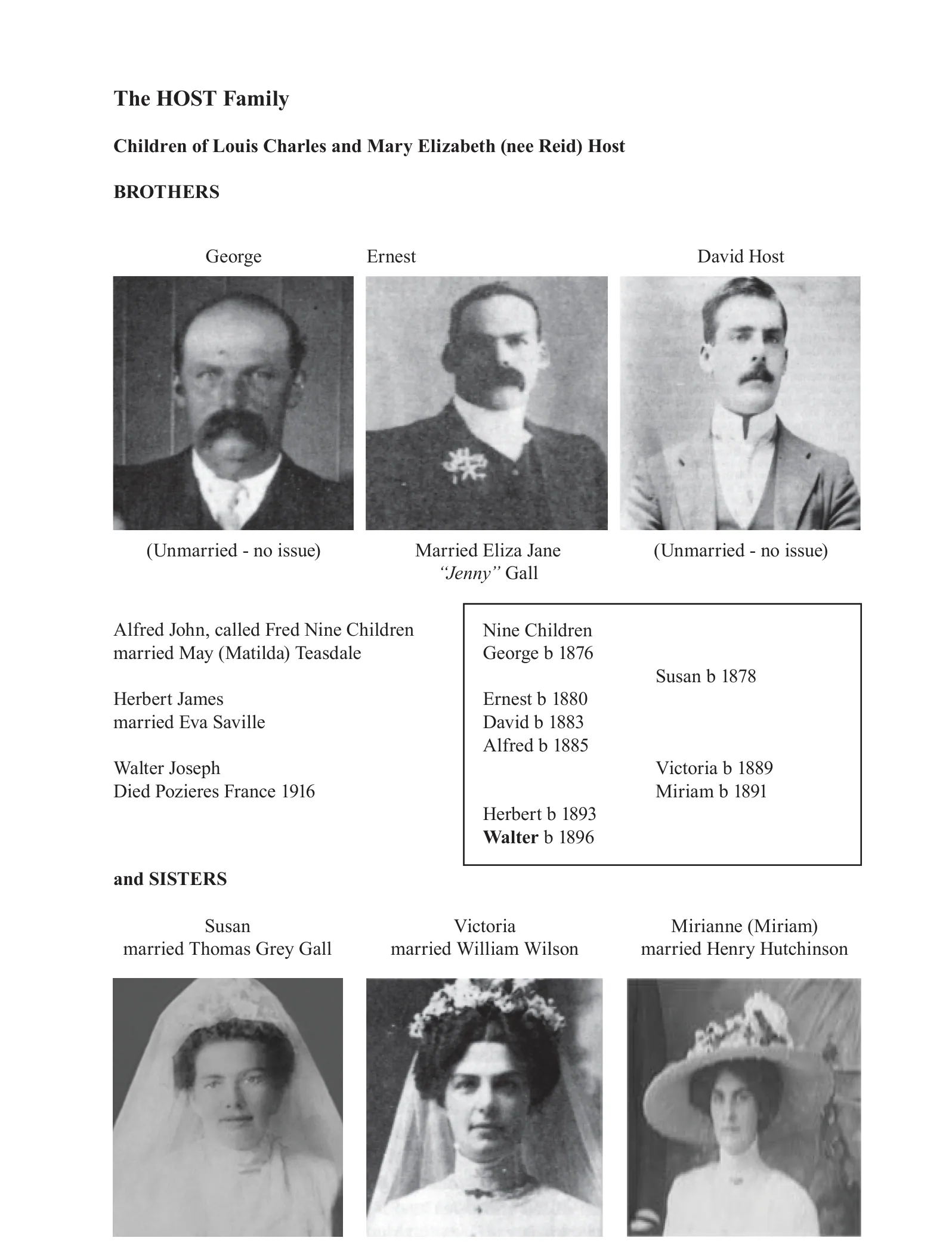
Text of the family chart (page 13)
- The HOST Family
- Children of Louis Charles and Mary Elizabeth (nee Reid) Host
- BROTHERS
- George
- Ernest
- David Host
- Alfred John, called Fred Nine Children married May (Matilda) Teasdale
- Nine Children George b 1876 Susan b 1878 Ernest b 1880 David b 1883 Alfred b 1885 Victoria b 1889 Miriam b 1891 Herbert b 1893 Walter b 1896
- Herbert James married Eva Saville
- Walter Joseph Died Pozieres France 1916
- and SISTERS
- Susan married Thomas Grey Gall
- Victoria married William Wilson
- Mirianne (Miriam) married Henry Hutchinson
The middle Host brother, called Alfred John, was to marry later in life after it had seemed that he too might remain single. As a young man, “Fred” Host was the life and soul of social activity in the small town of Berry but he did not settle down like his siblings and he later became a somewhat feckless figure. A relation once observed that “Fred” had borrowed money from his father to build a house and then “forgot to pay him back” and that he had done the same when he obtained a car. In later life, “Fred” became an auctioneer who went bankrupt in the mid 20s before moving to the city where he engaged in business and later became a travelling insurance salesman.
Over the years the two older sisters, Victoria and Mirianne, married and moved away from Berry. However Walter was close to his sisters, whom he called Vic and Millie and through the war years he wrote regularly to Victoria and her husband William Wilson and young Miriam. The two sisters both penned letters to the War Office when their brother was declared “missing” and later tried to console their devastated parents when word came that Walter had been wounded and then killed.
Young Herbert Host, who was three years older than his brother, might have been forgiven if he had developed a strong feeling of sibling rivalry or even jealousy towards the favourite youngest son, but as they grew older, the two boys remained close and when Walter went off to war in 1914 he named Herbert as both his beneficiary and also the administrator of his affairs. For his part Herbert was always a loyal friend to his youngest brother and he wrote regularly to inform Walter of the local news, the activities of friends and relations, as well as the gossip and chatter concerning the large family living in a small close knit community. Far from being jealous of his brother’s success, Herb was very proud of Walter’s achievements, which far exceeded anything he managed to do and in 1916 the two brothers discussed buying a station in the Northern Territory following Walter’s return home from the war.
Perhaps because they lived in such a small and rather isolated community and despite their occasional differences, Walter’s family were generally close and supportive of one another. As they reached maturity they lost any connection with their German relatives and when asked to provide details of their foreign relatives they had little knowledge of distant relations, apart from the fact that they knew they had an immigrant cousin living in Adelaide in South Australia and an uncle, an innkeeper called Herman, who resided in the state of Hesse in Germany.
In the later part of the 20th century Australians of Germanic descent experienced little animosity since they were generally regarded as devout, hard working and honest folk. The fact that many of Queen Victoria’s descendents had married into German royalty was widely known and, following the unification of the German states after 1870, the growing power and influence of the German nation caused little apprehension in Australia, even after Germany took control of New Guinea.
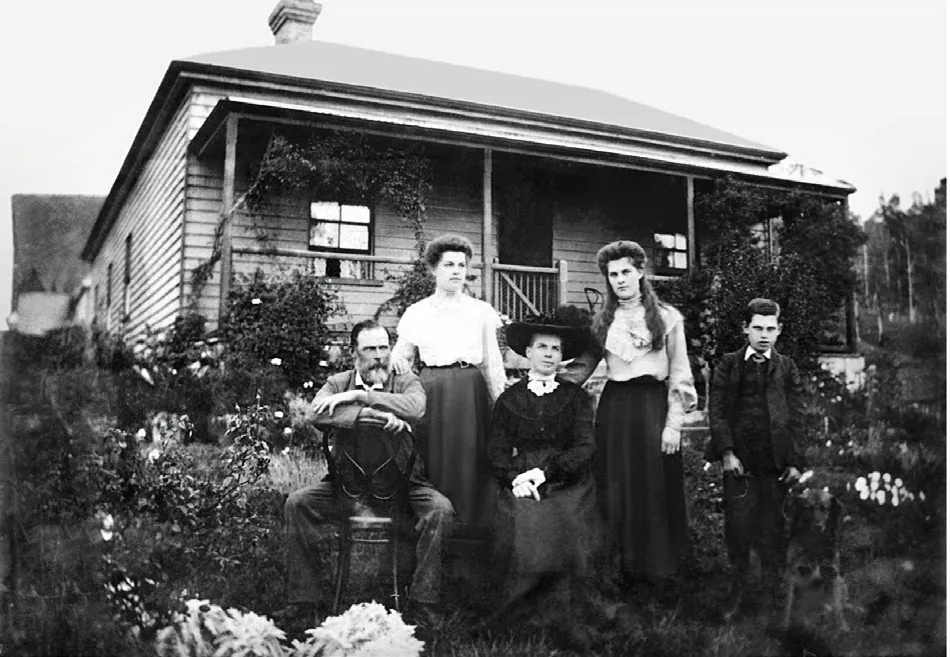
Seated, parents Louis and Lizzie Host, with Victoria, Miriam and Walter standing

The Host Family


1d Schooldays
Walter Host’s first six years were spent on the isolated farm at the end of Croziers Lane near Berry. In the 1870s the Host farm had been carved out of virgin rainforest, which then climbed up the steep valleys and hillsides and even as late as 1906, dead trees and stumps marked the places where the axemen had left isolated trees to provide patches of shade on hot summer days.
When an infant, Walter’s older siblings, Herbert and Millie, brought home from school the familiar childhood illnesses but the little boy escaped any serious diseases and he grew fit and healthy as he began to crawl and then take his first faltering steps. By the time the boy reached the age of six, he had begun lessons at the one teacher Jaspers Brush school, but his parents then decided to leave the isolated farm in the hands of his elder brother, Ernest. Having returned to his birthplace at Kiama, Louis Host became a committee man for the local hospital and the tourist promotion board. He purchased a house perched above the township with a magnificent outlook over the seaside village with its white lighthouse, sandy beach fringed by Norfolk Pines and the rocky Blowhole, which sent up white waves and sea foam when the Southerly Busters blew waves into the natural rock funnel.
By the time the family moved to Kiama after 1906, ten year old Walter, a natural athlete, had already shown great promise as a footballer and runner. From birth, Walter had been a bundle of energy, restless and easily bored by inactivity, constantly seeking some new way to exercise his strong physique and long legs and to fill his time or interest his curiosity. With strength beyond his years, Walter grew up without fear of man or animal and he seemed to delight in accepting dares or taking risks, where he was able exert to the limit his natural athletic prowess and strength.
With a keen eye and a strong right arm, Walter soon demonstrated that he was a born marksman - first with a sling-shot and later with a rusty rifle. Over his boyhood years Walter earned pocket money by killing warrens of rabbits, which had their burrows along the banks of Flying Fox Creek, which ran down the hillsides of his father’s property. By the age of ten, he had earned enough cash from the government bounty, which was paid to try and rid the country of the imported rabbits to be able to purchase a new rifle. Hardy and self sufficient, Walter often hunted alone at dusk while Herbie, although three years older, was content to remain at home to undertake the gory business of skinning the pests so that he too earned his share from his brother’s sharpshooting.

After the Hosts moved to Kiama, Walter missed the farm and its animals but he soon found schoolmates who joined him on shooting expeditions on the blue metal hillsides beyond the small township. It was not long before the intrepid hunters began to plead with their parents that they should be allowed to join the school cadets, where they would have the chance to “play soldiers” in a grown up fashion. By age twelve, Walter’s father had paid the fifteen shillings for his son’s uniform and thereafter the lad spent a night every week drilling on the local showground with wooden stakes used as substitute weapons because the newly created Federal government could not afford to equip cadets with real firearms.

Most school holidays were spent on the farm at “the Brush”, where Walter rode the farm ponies and helped Ernie and Herb with the milking, fencing and feeding the young animals. An exception was made at Easter, when the entire extended family travelled to Sydney to spend time with Mary (Lizzie) Host’s (nee Reid) relations and to enjoy the Grand Parade and the sideshows at the Royal Easter Show. However, once he had spent his money on the rides and roundabouts, and won a prize or two at the shooting ranges, Walter soon became bored and restless and nagged his mother to be allowed go home to take part in the Cadet Drill Night or to attend the outdoor cadet camp held in the second week of the school holidays.
Part of his dislike of the city visits was that Walter was expected to spend time with a relative for whom he had little liking. His cousin, Victor Waddell, was three years younger than Walter and, as an indulged only child, the lad spent his time in practising the violin and being “sickly”. Walter showed little respect for his relation, especially after his Aunt Vickie removed the boy from the Berry public school and enrolled him in a private city “academy”, where he could learn French and Music and not be “hit around the head”. The cousins showed little empathy towards each other and Walter even remarked that Victor, “probably deserved” punishment for being so “molly coddled”. The real difference between the two boys was that Victor disliked compulsory cadet training; he found the two hours of drilling on the Manly Oval “exhausting” and when he visited Berry he deliberately missed a drill session and consequently faced a stiff fine, until his doting mother “got him off” the punishment. For Walter, who greatly enjoyed everything associated with the cadet training, such reluctance was evidence that his cousin was “a slacker”, and since the two boys had nothing else in common they barely spoke to each other on the rare occasions when they met.
At school Walter was a middling but not exceptional student who wrote fluently and well but often struggled with spelling and grammar. He had a sound grasp of mathematics and an eager curiosity which meant that generally he enjoyed his classes and was popular with the teachers, who found him to be dutiful and helpful. Despite the complaints of his testy grandmother, elderly Susan Morrow, Walter was generally well mannered and obedient and his dress, conduct and attendance was always judged to be “very good”. By nature cheerful, outgoing and obliging, Walter was well liked by adults and popular with his mates, although the school girls sometimes found him a naughty tease. In the years to come Walter Host was to show the capacity to win and keep friends, even in the most desperate circumstances.
When, in 1911, Walter Host won a place in the Coronation Cadet Contingent and was absent overseas for seven long months, his deeds and opinions were faithfully recorded in the local Kiama press and this reportage attracted both admiration and envy among his peers and relations. When he returned to Berry with his Coronation Medal, young Walter became something of a local hero as well as being regarded as an adored “golden boy” by his loving parents and siblings.
1e Boy Soldiers
In 1911 Australia was still a boyish nation. The Commonwealth was just ten years old and too financially limited to be able to build a fine national parliament house, so the country was governed from temporary headquarters in Melbourne. The States were still squabbling like jealous siblings over many issues, such as the right for each province to have its own navy and Mother England was a long way distant from a colony which was struggling to forget its convict past and become a modern country.
The fledgling nation was well aware that its armed forces and equipment were inadequate for its own defence and in 1909-10 the British General, Lord Kitchener, was invited to visit the country to inspect the armed forces, and ultimately deliver a report on the state of the nation’s defences. Having carried out his assessment, Kitchener supported Australian public opinion and fears by stating that threats to national security could not be countered by volunteer forces alone and that conscription was essential. The General’s report of 1910 proposed that an Australian Militia force of 80,000 troops should be raised and maintained by a universal training scheme of conscripting youths as cadets in the 12 to 18 age bracket, who would then be enrolled into a volunteer Militia until aged 26.
The principle of Universal Training scheme whereby all fit boys would be enlisted for compulsory military training was accepted and legislated to commence in mid-1911. This meant that the first output from the inaugural Senior Cadets, inducted at age 17, would transfer into the volunteer local Militia units in 1912, thus steadily building up a trained national force until the final target was reached in 1919. The organisational side of the Kitchener Report proposed that the country should be divided, according to the electoral rolls, into 215 approximately equal training areas, each with a senior officer in command. These divisions, grouped by tens into larger state geographical districts, would incorporate a balanced mix of units approximating a brigade, with a superior instructor who was to become the brigade major of the formations should a war break out. Each of these 21 founding military districts was to have a cadet company, though this plan was to be increased progressively, so that eventually the corps would comprise 35 companies.
In early 1911, Australian cadet units were still voluntary with many youngsters being members of school or district corps under the management of local Defence League committees. The youths attended annual camps and undertook regular drills but their exercises were little more than bivouacs which relied on local contractors to supply tents and supplies; there was no national officer training school and the entire military organisation could best be described as enthusiastic but amateurish. However, there was by no means universal support for the scheme and the cadet training scheme was resisted by many parents and their sons and, despite fines being imposed by local magistrates, absenteeism and poor conduct among the junior soldiers remained a real problem.
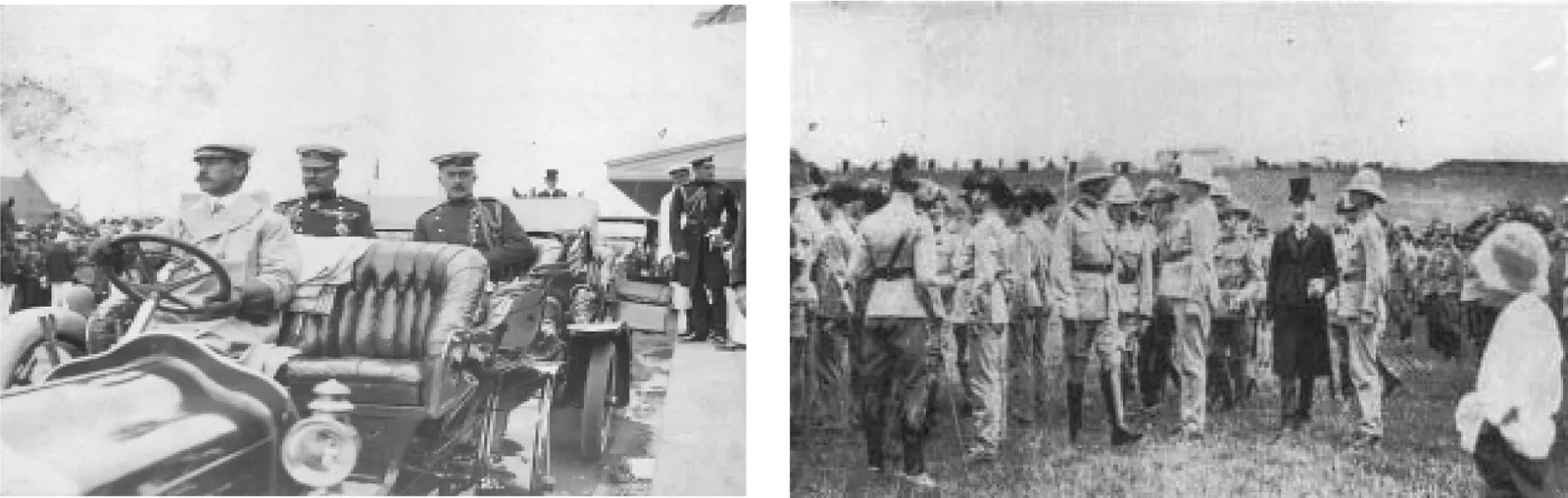
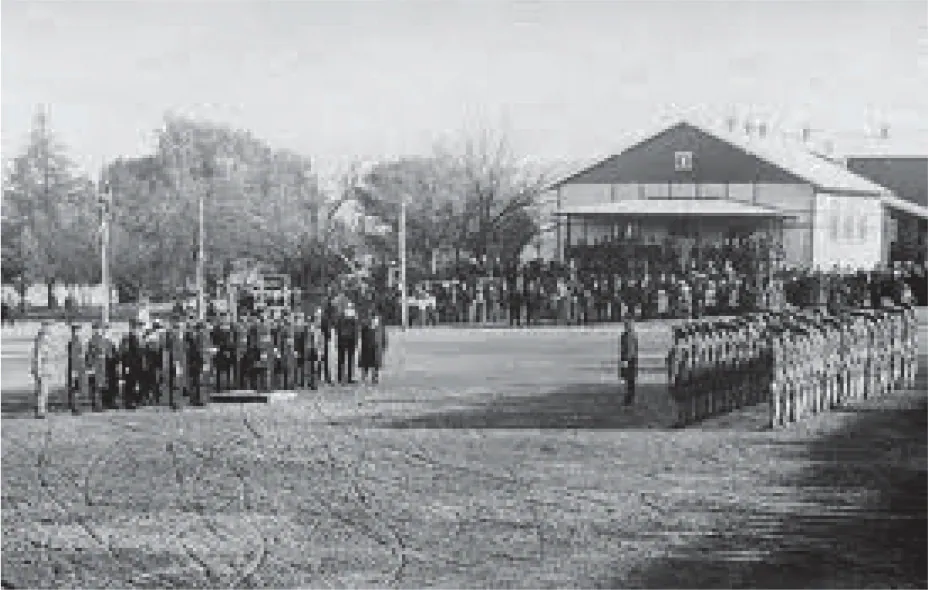
In 1906, Australian Cadet units were without any weapons and would have had to rely on improvised or borrowed equipment had they been called upon to defend the nation. By 1911, legislation was passed to make cadet service compulsory. Thus the appearance of the so called Coronation Cadets at the crowning of George V in England on June 22 coincided with the opening of the Royal Military College at Duntroon on the 27 June 1911, and the introduction of the Cadet system in Australia was celebrated by the Coronation Cadets at a church parade held in the distant capital of the British Empire, London.

By June 1911, the essential buildings for an officer training college had been constructed, the staff appointed and the first intake of 32 Australians and 10 New Zealanders had enrolled. The curriculum at the Royal Military College had originally been designed as a four-year course, with both military and academic subjects to be studied. However, because of the outbreak of the First World War, the first intake was specially graduated for overseas service after less than three years’ training. The courses of the next three intakes were also shortened and the majority of cadets in the first four intakes served with either the Australian Imperial Force (AIF) or the New Zealand Army. In total, forty of the initial 117 Australian graduates of the college were killed during the First World War.
The cadet tour of 1911 attracted much attention and wherever the Australian lads appeared during their tour of the UK, the youths were the subject of much favourable comment about their bearing and physical presence. This was hardly surprising since the boys had been selected from the entire state of NSW as representing the best type of youthful manhood, as well as for their skills in marksmanship, swimming and life-saving. Their various activities were widely reported by the press in Australia and whenever a newsreel featured the young soldiers, the audiences erupted into loud cheers. Their deportment was noted with pride, as were their displays of physical stamina and execution of military drills, gymnastics and marching. Displays of Australian life saving techniques and victories in shooting competitions, swimming and athletics earned much commendation and the British public were fascinated by the height, strong physiques and bright eyed enthusiasm of the young Australian trainee soldiers.
For their part, the Aussie lads, many of whom had never travelled beyond their bush towns, were suddenly exposed to the wonders of encountering princes and palaces, but they retained their composure and their frank, if somewhat naive comments, were widely reported. For many British people, whose only image of Australians was of shackled convicts dressed in rags or dangerous bushrangers in metal armour, these tall bronzed youngsters were a revelation of what had happened over little more than a century in the development of a far distant nation.

intended to be the
“building blocks” of
Australian national
defences
Enjoyed this sample?
This is one of two free sample chapters. The complete book, with all its chapters and pictures, is available as a soft copy (digital download) for $49.95 or a hard copy for $59.95, postage included in Australia.